Everything between the mill and your yard.
Buying and selling is the visible part of trading. The work that decides whether a shipment arrives correctly happens in six other places — and those are the parts we refuse to subcontract blindly.
How an order runs
From enquiry to delivered.
Specification
Grade, volume, packaging, delivery term and destination agreed in writing.
Sourcing
Allocated against existing stock or bought from a qualified mill on our account.
Inspection
Moisture, ash and fines verified before packing, with results on file.
Packing
Bagged, wrapped, palletised and labelled to your artwork and barcode.
Loading
Container, truck or bulk, photographed and sealed at the loading point.
Documents
Invoice, packing list, certificates and customs paperwork issued together.
01
Sourcing & purchasing
We buy on our own account, from mills we have visited, on terms we have negotiated ourselves. A buyer's order is never contingent on us going out to find stock first.
Our purchasing team works a standing base of producers across Lithuania, Latvia, Estonia, Sweden, Poland and Ukraine — pellet plants, briquette lines, firewood kilns, plywood mills and profiling operations. Some have supplied us for the better part of a decade. That length of relationship is what gets our loading slot honoured in November when everyone in Europe wants pellets at once.
We also buy outside Europe. South American mills ship to us in container lots on a running basis, and we go to North America when the arbitrage justifies the freight. A deep-sea position is a different trade from a truck out of Latvia — longer money, more paperwork, a bill of lading instead of a CMR — and it is one of the reasons we can hold a price when the European market tightens.
Because we are not tied to one plant, we can move an order when a mill runs short, substitute a comparable grade with the buyer's agreement, or split a large volume across producers to hold a delivery schedule. Buyers experience that as continuity. Internally it is simply the point of trading rather than manufacturing.
- Standing supplier base across the Baltics, Sweden, Poland and Ukraine, audited on site
- Ukrainian loads documented per consignment — export declaration, phytosanitary certificate and timber origin
- Container sourcing from South America, and North America when the market is right
- Purchasing on own account — we carry the position, not the customer
- Multi-mill allocation for volumes a single producer cannot hold
- Seasonal contracting ahead of the heating-season peak
02
Quality control
A rejected load at the destination costs everyone far more than a check at the loading point. So we check at the loading point.
Solid fuel is verified against the contracted grade before it is packed: moisture, ash, fines and net calorific value. Wood products are inspected for grade, moisture, dimension and profile consistency.
Where the deal calls for independent evidence, the work is done by a third party rather than by us. A vessel of pellets is always sampled and analysed independently before it sails; smaller consignments are tested when the contract or the destination requires it.
- Pre-loading verification against the contracted grade, not post-arrival
- Independent sampling and laboratory analysis where the deal requires it — standard on vessel cargoes
- Loading photographs and container seal numbers on record
03
Bagging & private label
A retail chain or a fuel distributor usually sells under its own name. That means the bag has to carry their artwork, their barcode and their declarations, and the pallet has to arrive ready for the shop floor.
For buyers building their own fuel brand, this is the whole proposition: they hold the customers and the marketing, we hold the material, the packing line and the logistics. It is the same line, to the same specification, that packs our own brands.
- Retail bags, shrink packs, boxes, nets, bundles, crates, big bags and bulk — sized to the destination
- Full private label — artwork, EAN barcodes, declarations, pallet labels
- Retail-ready pallet patterns and stretch-hood wrapping
- Batch coding for traceability back to the producing mill
04
Loading & transport
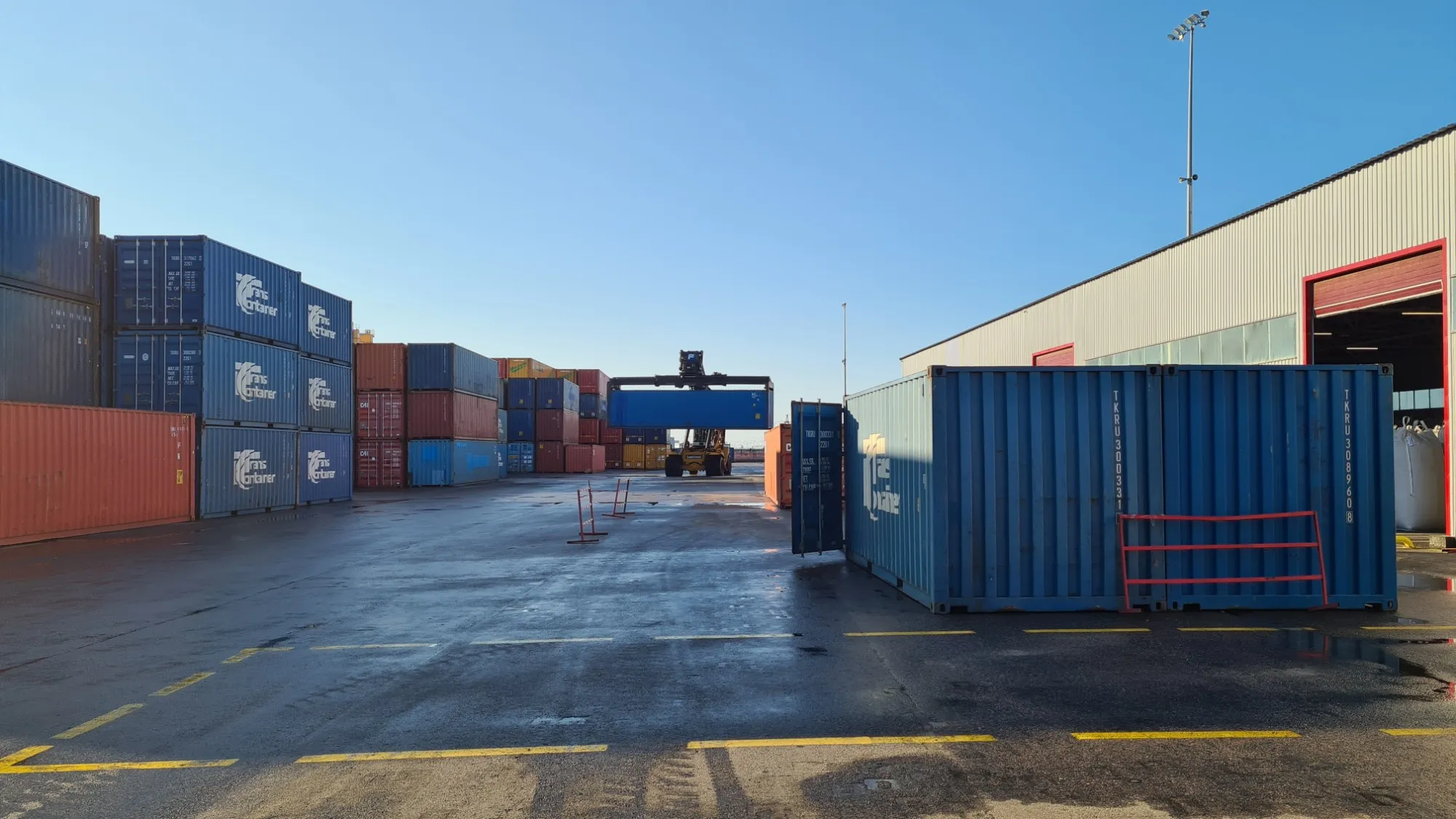
More than a million tonnes moved since 2017, on freight we contract ourselves.
Volume moves in full truck loads across Europe and in containers on the deep-sea routes. We hold the relationships with the hauliers, the forwarders and the shipping lines, so one company is answerable for both the goods and their arrival. A buyer whose load is late calls the trader who sold it, not a haulier who has never heard of them.
Loading is booked against the buyer's delivery window rather than the mill's convenience. That is the practical reason we buy on our own account and carry the freight: it is the only way to commit to a date and keep it when a mill runs behind.
- Full truck loads across Europe · containers on deep-sea routes
- Freight contracted by us — hauliers, forwarders and shipping lines
- One counterparty for goods and freight — one invoice, one point of recourse
- The trader who sold the load follows it from loading to delivery
05
Terminals & storage
Demand for heating fuel is not evenly spread across the year, and mills cannot produce a winter's worth of pellets in November.
We hold buffer stock through the year — close to the ports for export volume, and close to the customer where fast replenishment matters. That inventory is what lets us answer "can you deliver next week" in the middle of a cold snap, when a producer's own order book is already three weeks deep.
For contracted buyers we will hold agreed volumes as call-off stock, so their yard is not financing a season's material and their supply is not exposed to a spot market that moves against them in December.
- Buffer inventory held through the year, not only in season
- Covered storage protecting moisture specification
- Call-off stock arrangements for contracted volumes
- Positions near port and near market for fast replenishment
06
Documentation & compliance
Wood is one of the most heavily regulated commodities moving inside the European Union, and the burden has grown, not shrunk. We carry it so our customers do not have to build a compliance function of their own.
Every consignment is supported by legality due diligence on the origin of the material, in line with the EU Timber Regulation and the Deforestation Regulation that replaces it. Where a market or a customer requires certified material, we source against chain-of-custody schemes and pass the claim through correctly on the invoice — a certification claim made loosely is worse than none at all.
Alongside that sits the ordinary machinery of cross-border trade: phytosanitary certificates and heat-treatment declarations where the destination requires them, and the fuel-quality declarations that go with certified pellet grades.
We handle customs ourselves rather than leaving it to the buyer. Import and export formalities, the declarations and the duty position are arranged on our side of the transaction, which is why a deep-sea container and a truck from Latvia reach the customer the same way — as goods delivered, not as a clearance problem that arrives first.
- Legality due diligence on origin — EUTR and EUDR
- Chain-of-custody certified material sourced on request
- Fuel quality declarations for certified pellet and briquette grades
- Customs handled on our side — import and export formalities, declarations and duty position
- Phytosanitary and heat-treatment documentation by destination
Bring us the difficult part of the order.
Odd packaging, a tight loading window, a destination with awkward paperwork — those are the conversations we would rather have early.